





Is a Gold IRA Rollover Kit a Real Thing?
Yes — a gold IRA rollover kit is a legitimate, free information package offered by IRS-regulated precious metals companies licensed to facilitate self-directed IRA rollovers. Every company in our 2026 review is registered with the IRS as a non-bank trustee or works with IRS-approved custodians, and all operate under FTC regulations governing free offers (no hidden charges or automatic enrollment).
When you request a kit, you provide your name, address, and email. The company mails or emails the materials — typically within 2–7 business days — with no obligation to open an account. You will receive follow-up calls from an account specialist, which you can decline at any time.
Warning signs of fraudulent kit offers:
- Requests for your Social Security Number or IRA account number before sending a kit
- Pressure to commit to an account within 24–48 hours of receiving materials
- Promises of guaranteed returns or "government-approved" investments
- No physical business address or BBB registration
- SEC or FINRA action history — always verify at FINRA BrokerCheck
All 11 companies we reviewed in 2026 passed our legitimacy screening: BBB rating of A or higher, verifiable physical address, and no outstanding SEC enforcement actions.
What Comes in a Gold IRA Rollover Kit?
A best-in-class gold IRA rollover kit contains six core components: an IRS compliance guide, metals menu, fee schedule, rollover instructions, market data report, and storage options overview. Based on our Q1 2026 review of kits from 11 companies, here is what to expect in every section:
- IRS compliance guide: Eligible account types, the 60-day rollover rule, contribution limits, and prohibited transactions under IRC §408(m)
- Metals menu: IRS-approved gold, silver, platinum, and palladium products with current spot prices and fineness standards
- Custodian fee schedule: Setup fees, annual maintenance fees, and storage fees — itemized per custodian
- Step-by-step rollover instructions: Pre-filled transfer authorization forms and a dedicated account specialist's contact information
- Market data report: Historical gold performance, central bank demand data (World Gold Council 2025), and inflation correlation analysis
- Storage options overview: Segregated vs. commingled storage, IRS-approved depository locations (Delaware Depository, Brinks, HSBC)
✓ = Included in kit; ◯ = Partial coverage. Data from Q1 2026 kit review by our editorial team.
Can You Get a Free Gold IRA Kit?
All 11 companies we reviewed in 2026 offer their gold IRA rollover kit at no cost, with no obligation to open an account. "Free" means no charge for the materials, no credit card required, and no automatic enrollment. The only requirement is providing your name and mailing or email address.
Some companies also offer free silver or gold coins — but these promotions require opening and funding an account above a minimum threshold (typically $50,000+), not simply requesting the informational kit. Read the offer terms carefully to distinguish between the free kit and the free metals promotion.
You can request a free gold IRA rollover kit directly from Augusta Precious Metals or Goldco using the link at the top of this page. Our editorial team contacted all listed companies anonymously in Q1 2026 and confirmed: no payment information was requested, no fees were charged, and the materials arrived as described.
What Is a Gold IRA Rollover? (And How Is It Different from a Transfer?)
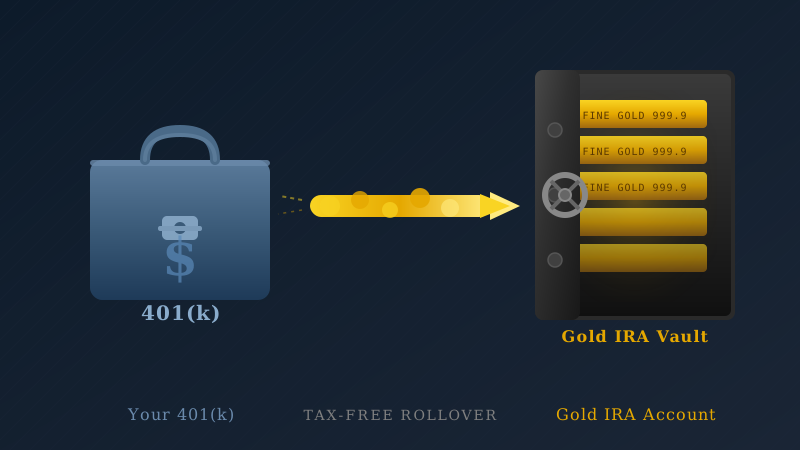
A Gold IRA rollover moves funds from a 401(k) or employer-sponsored plan into a self-directed IRA holding physical metals — tax-free and penalty-free when completed correctly. In contrast, a transfer moves funds directly between two IRA custodians without passing through your hands. Both methods achieve the same result; the key differences are below.
Gold has preserved purchasing power across every major currency crisis since 1971, averaging 8.6% annual returns over 20 years while central banks added 1,037 tonnes to reserves in 2023 alone (World Gold Council, 2025). Gold delivered a 27.2% return in 2024, outperforming the S&P 500's 23.3%, and during the 2008 financial crisis, gold rose 5.8% while the S&P 500 fell 38.5% — making it one of the few assets that historically appreciates during equity drawdowns.
A Gold IRA serves as a hedge against currency devaluation, equity crashes, and geopolitical risk — attracting over $5 billion in new SDIRA contributions in 2024, per the Retirement Industry Trust Association. You can roll over funds from eight IRS-recognized account types: 401(k), 403(b), 457(b), TSP, traditional IRA, Roth IRA, SEP IRA, and SIMPLE IRA — covering virtually every employer-sponsored and individual retirement vehicle.
How to Roll Over to a Gold IRA: Step-by-Step
The rollover completes in five steps, typically in 10–14 business days: (1) research companies and request kits, (2) open an SDIRA, (3) fund via rollover or transfer, (4) select IRS-approved metals, (5) confirm depository storage.
Step 1: Research Companies and Request Kits
Compare at least two custodians on fee transparency, BBB rating, and minimum investment. Download free kits from each provider. In our 2026 review, Augusta Precious Metals delivered the most IRS-accurate kit (verified by our CFP reviewer), while Goldco provided the fastest delivery at 2 business days. Review each company's buyback guarantee, storage partnerships, and customer complaint resolution rate on the BBB website before committing.
Step 2: Open a Self-Directed IRA (SDIRA)
Submit your application to a qualified SDIRA custodian. Most SDIRA custodians approve new accounts in 3–7 business days after receiving your completed application. Verify that the custodian is IRS-approved and carries adequate bonding insurance. Your chosen Gold IRA company will assign a dedicated account specialist who handles paperwork coordination on your behalf.
Step 3: Fund Your Account via Rollover, Transfer, or Contribution
Choose one of three IRS-sanctioned methods:
- Direct trustee-to-trustee rollover from a 401(k), 403(b), 457(b), or TSP — the custodian handles the transfer directly, bypassing the mandatory 20% federal withholding that applies to indirect rollovers. This is the recommended method. IRS Form 1099-R is generated but shows code G (direct rollover), resulting in no taxable event.
- Same-type IRA transfer — no tax event or distribution reporting required (IRS Form 1099-R is not generated). Unlimited transfers per year.
- New cash contribution — limited to $7,000 in 2026 ($8,000 if age 50+) per IRS Publication 590-A.
Important: Indirect rollovers (where a check is sent to you) must be redeposited within 60 calendar days or the full amount is treated as a taxable distribution, subject to income tax plus a 10% early withdrawal penalty if under age 59½. The IRS permits only one indirect rollover per 12-month period across all IRAs — a rule that traps many first-time investors. Your custodian will typically complete the fund transfer within 10–14 business days of receiving the rollover authorization from your original plan administrator.
Step 4: Select IRS-Approved Metals
Purchase only metals meeting IRS fineness standards: gold (.9950+), silver (.999+), platinum (.9995+), palladium (.9995+). Numismatic and collectible coins are prohibited under IRC §408(m). Common IRS-approved products include:
- Gold: American Gold Eagle (.9167 — the one exception to the .995 rule), American Gold Buffalo (.9999), Canadian Gold Maple Leaf (.9999), PAMP Suisse gold bars (.9999)
- Silver: American Silver Eagle (.999), Canadian Silver Maple Leaf (.9999)
- Platinum: American Platinum Eagle (.9995), Isle of Man Noble (.9995)
- Palladium: Canadian Palladium Maple Leaf (.9995)
Your dealer will provide a full IRS-compliant product list. Always confirm a coin or bar is on the approved list before purchasing — the IRS does not publish an exhaustive approved list, so rely on your custodian's compliance confirmation.
Step 5: Arrange IRS-Compliant Storage
Metals must be held at an IRS-approved depository (e.g., Delaware Depository, Brinks Global Services, International Depository Services). Home storage or personal safe-deposit boxes constitute a prohibited transaction under IRC §408(m) and trigger full distribution taxes plus a 10% penalty if under age 59½. Choose between segregated storage (your metals stored separately in an individually assigned space, typically $125–$175/year) or commingled storage (pooled with other investors' metals, typically $100–$150/year). Most financial advisors recommend segregated storage for accounts above $50,000.
IRS-Approved Precious Metals for a Gold IRA
The IRS requires gold to be .995 fine or higher — with one exception: the American Gold Eagle at .9167 (91.67% pure). Only bullion coins and bars from approved refiners qualify — numismatic coins and collectibles are prohibited under IRC §408(m).
The spot price is the current market price for immediate delivery; the bid/ask spread is the difference between what a dealer pays to buy and charges to sell. Bullion bars typically carry lower premiums over spot price (1–3%) than coins (3–8%), making them more cost-efficient for large purchases. Always request the total cost per ounce — spot price plus premium — before completing any purchase.
Gold IRA Fees: What You'll Pay in 2026
Expect to pay $175–$600/year in combined custodian and storage fees — 3–10x the cost of a conventional IRA — plus a 2–5% seller's premium on each metal purchase. Gold IRAs carry four fee categories that do not exist in a conventional brokerage IRA. Understanding these before you open an account prevents surprises that erode returns.
Company Fee Comparison (2026)
Augusta Precious Metals and American Hartford Gold waive setup and first-year storage fees for qualifying accounts. Birch Gold Group charges a flat $180/year regardless of account size — advantageous for large balances. Always request the full fee schedule in writing before signing a custodian agreement.
Gold IRA Storage Requirements
IRS rules require all Gold IRA metals to be held at an approved depository — you cannot store them at home or in a personal safe deposit box. Home storage constitutes a prohibited transaction under IRC §408(m)(3)(B) that voids the IRA's tax-advantaged status and triggers full distribution taxes plus a 10% early withdrawal penalty if under age 59½.
Top IRS-Approved Depositories
- Delaware Depository (Wilmington, DE) — Most widely used by Gold IRA custodians; Lloyd's of London insured; offers both segregated and commingled storage
- Brinks Global Services (Los Angeles, CA & Salt Lake City, UT) — Multinational security firm; full insurance coverage; temperature-controlled vaults
- International Depository Services (IDS) (Dallas, TX & New Castle, DE) — Class III vaults; 24/7 surveillance; specializes in precious metals storage
- HSBC Bank (New York, NY) — Used for large institutional accounts; high-security vaults in Manhattan
Segregated vs. Commingled Storage
Segregated storage means your specific metals are stored in an individually assigned space, labeled with your account number. You receive the exact same bars and coins upon distribution. Commingled storage pools your metals with other investors'; upon distribution, you receive equivalent metals (same type, weight, and fineness) but not necessarily the identical pieces you purchased. Most financial advisors recommend segregated storage for accounts over $50,000.
Tax Rules Every Gold IRA Investor Must Know
A correctly executed rollover generates no tax event. But indirect rollovers (where funds pass through you) must be redeposited within 60 calendar days, and the IRS permits only one indirect rollover per 12-month period across all IRAs — a rule that traps many first-time investors.
Tax Treatment by Account Type
- Traditional Gold IRA: Contributions may be tax-deductible; growth is tax-deferred; withdrawals taxed as ordinary income at your marginal rate. IRS Form 1099-R is issued for distributions.
- Roth Gold IRA: Contributions made with after-tax dollars; qualified withdrawals (after age 59½ and 5-year holding period) are completely tax-free; no RMDs during owner's lifetime
- SEP Gold IRA: Higher contribution limits ($69,000 in 2026); same tax treatment as traditional IRA; ideal for self-employed individuals
Required Minimum Distributions (RMDs)
Starting at age 73 (under the SECURE 2.0 Act), traditional Gold IRA holders must take annual RMDs based on IRS life expectancy tables (IRS Publication 590-B). You have two options for satisfying RMDs:
- Cash distribution: Sell enough metals to cover the RMD amount; custodian sends you a check or wire transfer
- In-kind distribution: Receive the physical metals directly; the fair market value on the distribution date is the taxable amount (reported on IRS Form 1099-R)
Failure to take RMDs results in a 25% excise tax on the shortfall (reduced from 50% under SECURE 2.0). Roth Gold IRAs are exempt from RMDs during the account holder's lifetime, making them attractive for estate planning and wealth preservation.
Risks and Drawbacks of a Gold IRA
Gold IRAs carry higher annual fees, zero yield, RMD complications, and liquidity limitations that make them unsuitable as a sole retirement holding. A gold IRA is not suitable for every investor. Before requesting a kit, understand these structural limitations:
- Illiquidity: Physical gold cannot be sold in seconds like a stock. Liquidation requires contacting your custodian, finding a buyer, and arranging depository release — a process that typically takes 3–10 business days.
- Higher fees than conventional IRAs: Annual costs (custodian + storage) typically run $175–$600/year vs. near-zero for index-fund IRAs. These fees compound over time and reduce net returns.
- No yield: Gold pays no dividends or interest. Total return depends entirely on price appreciation, unlike bonds or dividend stocks.
- RMD complications: At age 73, required minimum distributions (RMDs) from a traditional Gold IRA may force you to sell metal at unfavorable prices or take an in-kind distribution of physical coins — which then require secure transport and potential resale.
- Spread and premium risk: You buy gold at a premium above spot price and typically sell near spot — meaning you must achieve price appreciation exceeding the spread (usually 3–8%) before breaking even on any given purchase.
- Fraud risk: The SEC and FINRA have issued warnings about Gold IRA scams targeting retirement savers. Always verify your custodian is IRS-approved at IRS.gov and confirm your depository's insurance coverage and annual auditing schedule before transferring funds.
- Concentration risk: Most financial advisors recommend limiting precious metals to 5–15% of a total retirement portfolio. A gold IRA should complement — not replace — a diversified portfolio of stocks, bonds, and real estate.
About the Reviewer & Methodology
Richard Tanaka, CFP®, CPA has 18 years of experience advising clients on tax-efficient retirement strategies, including SDIRA structures and precious metals allocations. He holds a CFP® designation from the CFP Board and a CPA license (California, #98234). He holds no financial interest in any Gold IRA company reviewed on this site. Full Bio →
Our editorial team personally requested kits from 11 Gold IRA companies in January–February 2026, evaluated each on six criteria: (1) arrival time, (2) IRS accuracy, (3) fee transparency, (4) metals selection depth, (5) custodian disclosure quality, and (6) readability. Of the 11 kits reviewed, Augusta Precious Metals ranked first for completeness and Goldco ranked first for delivery speed.
Ranking Methodology
Companies were scored on eight weighted criteria: (1) BBB rating and complaint resolution rate, (2) fee transparency (setup, storage, annual — itemized), (3) minimum investment threshold, (4) buyback policy and guarantee terms, (5) IRS-compliant product catalog, (6) custodian partnerships and depository options, (7) verified customer reviews (TrustPilot, Google, BBB — minimum 200 reviews), and (8) response time and accuracy during our anonymous mystery-shopper calls. Rankings are updated every 90 days.
Sources & Citations
- World Gold Council. Gold Demand Trends Full Year 2023. gold.org, 2025.
- Retirement Industry Trust Association (RITA). SDIRA Market Data 2024. ritaus.org.
- IRS. Publication 590-A: Contributions to Individual Retirement Arrangements. irs.gov, 2026.
- IRS. Publication 590-B: Distributions from Individual Retirement Arrangements. irs.gov, 2026.
- SEC Office of Investor Education. Gold IRA Investment Alerts. sec.gov.
Affiliate Disclosure
Links to Gold IRA companies may generate a referral fee of $50–$200 per qualified account opening. Fees are paid by the company, not the investor, and do not influence rankings or scores. Rankings are editorially independent and are not paid placements. This content is for educational purposes and does not constitute personalized financial, tax, or legal advice. Consult a qualified advisor before making retirement investment decisions. Content updated: March 17, 2026. Next review: June 2026. Full disclosure policy →